
Criminal Cases in the Guadalupe County Courts
Guadalupe County criminal court cases divide by charge level. The 25th, 2nd 25th, 274th, and 456th District Courts have original felony jurisdiction. The District Clerk keeps the pleadings and other filed papers for those cases. County Courts at Law hear Class A and Class B misdemeanors, and the County Clerk maintains those records. A case number often signals the court, but the reader should confirm the court name shown on the docket before ordering a copy.
Justice courts and city municipal courts keep other criminal dockets. They handle eligible fine-only state-law matters and local ordinance cases within their own jurisdiction. Those files may not sit with either county clerk. The county's justice court directory identifies current precinct offices. A city court remains the source for its own filed case, even if a later custody event appears in the county jail system.
Guadalupe Felony and Misdemeanor Files
The most useful first choice is not a person's name. It is the case level. A felony filing belongs with the District Clerk. A Class A or B misdemeanor belongs with the County Clerk. Both work from the court complex at 211 W. Court Street in Seguin, but they are separate custodians. Sending a request to the wrong desk can delay a Guadalupe County court record search.
District Clerk Criminal/Collections
211 W. Court Street, Suite 209
Seguin, TX 78155
(830) 303-8875
Monday-Friday, 8:00 a.m.-4:30 p.m.
dccourts@guadalupetx.gov
County Clerk Courts
211 W. Court Street, third floor
Seguin, TX 78155
(830) 303-8861
ccrecords@guadalupetx.gov
The District Clerk is the direct fallback for felony documents that are not exposed online. The County Clerk court service also offers electronic certified records for misdemeanor cases.
How to Search Case Records
Start with the county's official route to judicial records search. It leads to Guadalupe Tyler Public Access, which separates criminal case, criminal hearing, bond, and jail routes. Use a case number when possible. For a name search, compare the court, filing date, case number, and charge rather than treating one matching name as conclusive.
- Open the official records-search route and choose the criminal case category, not the jail or bond path.
- Enter the local case number. If it is unknown, search by the displayed party name.
- Compare the filing date, court, case type, and charge to distinguish similar names.
- Open the summary and read docket events, filed charges, disposition, judgment, and sentence separately.
- Ask the correct clerk for the actual document or certified copy when the portal summary is not enough.
| Search field | Type | Required | Use |
|---|---|---|---|
| Search category | Menu | Yes | Select criminal case rather than booking or bond. |
| Name or party | Text | No | Compare multiple record details before identifying a match. |
| Case number | Text | No | The strongest route to a known Guadalupe County case. |
| Court and case type | Filter or result | No | Distinguishes felony, misdemeanor, and lower-court matters. |
| Filing date | Date or result | No | Helps narrow a common-name search. |
The portal summary is a finding aid. Order the complaint, information, indictment, judgment, or other filed paper when its exact language controls the answer.
Guadalupe Tyler Case Search
The Guadalupe Tyler Public Access portal is the local court search, bond, and jail interface. It answers different questions through different categories. A criminal case search follows filed charges and court events. A booking search follows intake and custody. Confusing the two can make an arrest allegation look like the final filed charge.
The county's official records-search page shows where the local judicial search begins. The image below preserves that source without displaying any private case.
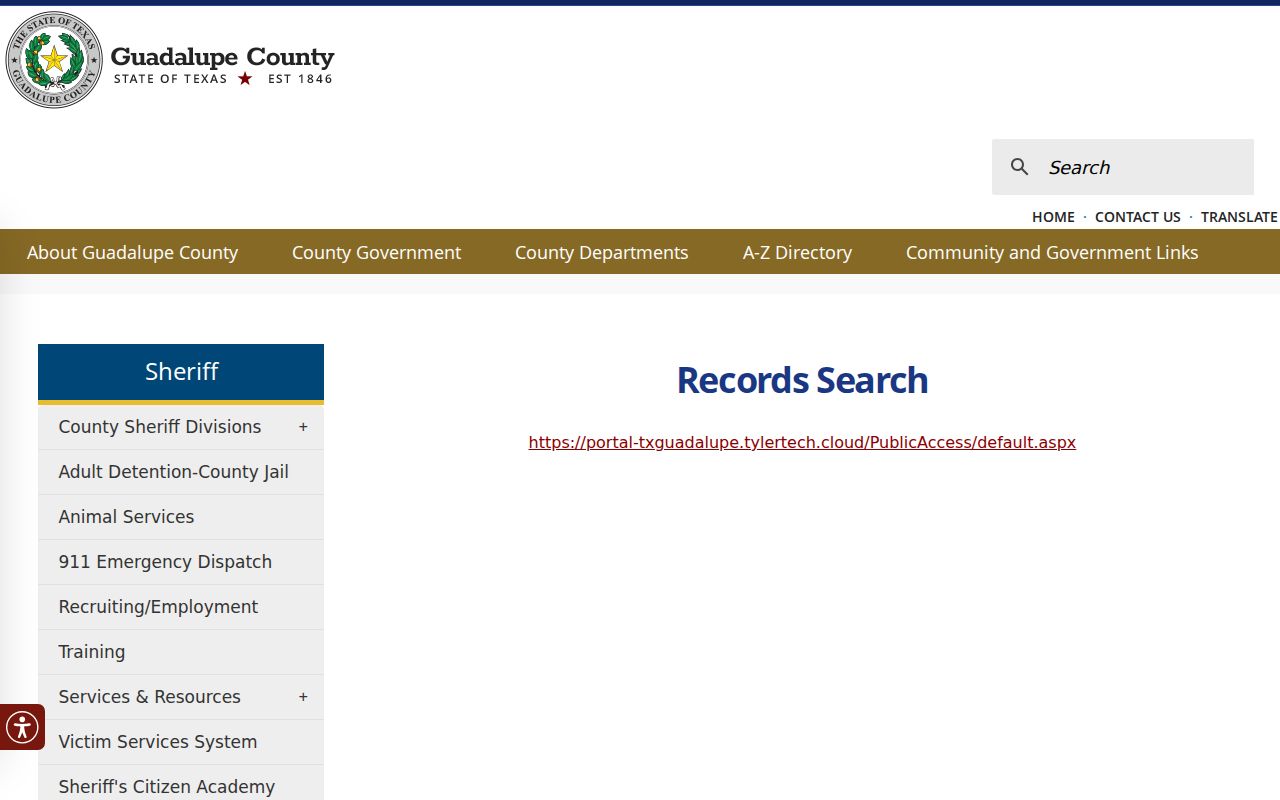
Use the portal as an index, then obtain the filed pleading, order, or certified judgment from the responsible clerk when accuracy depends on the document itself.
Note: re:SearchTX is statewide and account-based, but its public portal does not supply Guadalupe County criminal case records.
What the Case File Shows
A Guadalupe County case file is organized around a local court action. It can show the charging paper, settings, pleas, motions, rulings, judgment, and sentence. It is not the same as a DPS rap sheet, which links reported arrest cycles and dispositions statewide. Nor is it the jail record, which focuses on booking, custody, bond, and release. Reading the court file keeps the filed case separate from the first allegation.
| Case Number & Court | Identifies the local file and the court responsible for it. |
|---|---|
| Charging Document | Shows the complaint, information, indictment, or other lawful filed charge. |
| Docket Entries | Chronological record of settings, filings, pleas, motions, and orders. |
| Hearing Dates | Lists court settings when they are entered and public. |
| Disposition & Judgment | States how a charge or case ended and records the court's judgment. |
| Sentence & Conditions | Records punishment and court-ordered terms after a conviction. |
Documents may be listed without being downloadable. A certified copy must come from the clerk that holds the original Guadalupe County court case.
Note: A case status is only a snapshot; read the dated docket entries and final signed order before stating the outcome.
Guadalupe Charging Terms Explained
The charging paper helps explain why a Guadalupe County booking entry and court file may differ. A complaint is a sworn allegation that starts or supports a charge. An information is filed by a prosecutor and is commonly used for a misdemeanor. An indictment is a grand jury's charging instrument, most often associated with felony prosecution. None of these labels alone states the final result.
- Arraignment
- A proceeding where the charge is addressed and a plea may be entered.
- Disposition
- The outcome of a charge or case, such as conviction, dismissal, or acquittal.
- Nolle prosequi
- A prosecutor's formal decision not to keep pursuing a charge.
- Deferred adjudication
- Supervision after a plea or finding while adjudication is delayed, subject to the later outcome.
The filed charge controls the court case. To trace the earlier custody event, use the separate Guadalupe County arrest history channels.
Stages of a Criminal Case
After arrest and magistration, prosecutors review the facts and choose what charge to pursue. Felony prosecution may proceed through a grand jury indictment or another lawful charging path. The court then handles arraignment, discovery, pretrial motions, a negotiated plea or trial, judgment, sentence, and any appeal. A stage can produce a docket entry even when the portal does not display the underlying document.
Case flow: Charges Filed › Arraignment › Pretrial › Plea or Trial › Disposition › Sentencing
There is no researched fixed timetable for each Guadalupe County stage. Scheduling depends on the court and the case. The docket is the better source for what has happened in one matter.
Read Guadalupe Court Results Separately
Bond, costs, and disposition answer three different questions. Bond concerns release and appearance while a case is pending. Court costs and fines are financial entries. Disposition states the outcome. A paid amount does not by itself explain whether a charge was dismissed, deferred, or ended in a conviction. Open the judgment or final order when the result matters.
The County Clerk's online payment instructions warn that the route is for misdemeanors only. Users should call the clerk first, use a case number, and not pay before the hearing. The page excludes probation, justice-court, felony, and family payments. That warning shows why a payment screen is not a full Guadalupe County criminal docket.
Note: Read every charge count separately because one Guadalupe County case may contain outcomes that differ from count to count.
Older Guadalupe Cases and Certified Copies
An online miss is not a clerk certification that no case exists. For an older or unavailable file, contact the responsible clerk with the case number, court, displayed defendant name, and approximate year. The District Clerk's Criminal/Collections desk is the reliable fallback for felony papers. Its Schertz satellite at 1101 Elbel Road is open weekdays from 8:00 a.m. to 4:00 p.m., but a visitor should first confirm that the requested felony copy can be supplied there.
For Class A and B misdemeanors, the County Clerk offers online purchase of tamper-evident electronic certified court records by credit card and email delivery. A docket page may still require authentication, or it may list an event without exposing the paper. Certification comes from the clerk responsible for the case, not from a screenshot of the search results.
Note: Call the Schertz satellite before traveling because the county does not promise that every felony copy can be fulfilled there.
Access & Restrictions
Public access does not mean every field or paper appears online. Judicial records follow court and clerk access rules. The Texas Public Information Act governs agency records, while court files also operate under the judicial access framework. Confidential juvenile material, protected victim details, personal identifiers, active-investigation information, and sealed or expunged records may be withheld, redacted, or absent.
If a known Guadalupe County case does not appear, ask the clerk whether it is older, not fully indexed, confidential, sealed, or held in another court. Describe the case precisely. A sheriff request cannot compel the District Clerk to provide a felony pleading, and a District Clerk request does not reach a municipal court file. The office that holds the original record remains the source.