
How to Check Criminal History in Guadalupe County
Start with the part of the record that answers the question. Guadalupe County judicial cases, bonds, and current or recent jail entries route through the county's Tyler Public Access system. Felony pleadings and certified copies belong with the District Clerk. Class A and B misdemeanor files belong with the County Clerk. An incident narrative stays with the agency whose officer wrote it, even if the person later entered the Guadalupe County jail. The Texas Department of Public Safety holds the statewide criminal-history repository.
Gather a full name, spelling variants, an approximate date, and any case or booking number. A precise identifier is safer than a common-name match. Then work through the official record chain:
- Choose the case, bond, or jail category that fits the event.
- Search by case or booking number when one is known; otherwise use the full name and compare dates.
- Check the court, filed charge, case status, and bond data before deciding that a result is the right record.
- Ask the responsible clerk or arresting agency for the source document when the summary is not enough.
- Use DPS personal review for your own fuller Texas record or an official correction process.
Search Guadalupe County Tyler Records
The county's main online route leads to Guadalupe Tyler Public Access. Its service categories separate criminal cases, hearings, bonds, jail records, and other judicial material. That split matters. A jail result describes custody, while a case result reflects what prosecutors filed and what the court later did. Free portal access also does not mean that every scanned document is available without a request.
The official Tyler screen shows the entry point used for Guadalupe County criminal record searches.
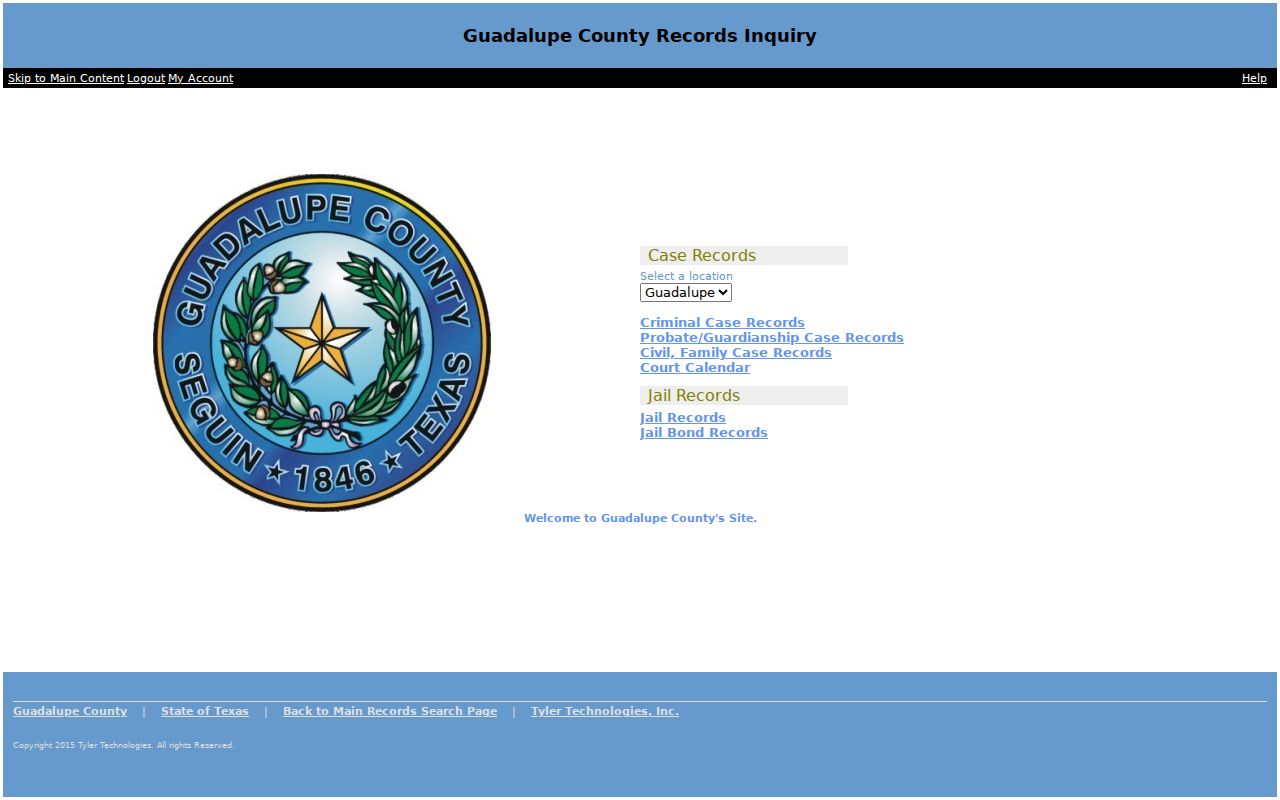
Use the most exact field available, then confirm several details before relying on a hit.
| Portal route | Best starting detail | What to verify |
|---|---|---|
| Criminal case | Case number or party name | Court, filing date, charge, and status |
| Bond | Case or person identifier | Amount, type, court, and current status |
| Jail record | Booking identifier or exact name | Booking date, agency, charges, and release status |
Official Texas Background Checks
The Texas Department of Public Safety Crime Records Division offers a public conviction and deferred-adjudication name search. Users create an account and buy credits. The product is useful for reported statewide results, but it is not a full personal rap sheet. It depends on names, birth details, identifiers, and reporting from agencies and courts. DPS warns that fingerprints provide the positive identity link. A search may consume a credit even when it returns no match.
For review of your own Texas record, follow the DPS personal-review procedure and use FAST electronic fingerprints through IdentoGO. The official enrollment screen begins the appointment and identity process.
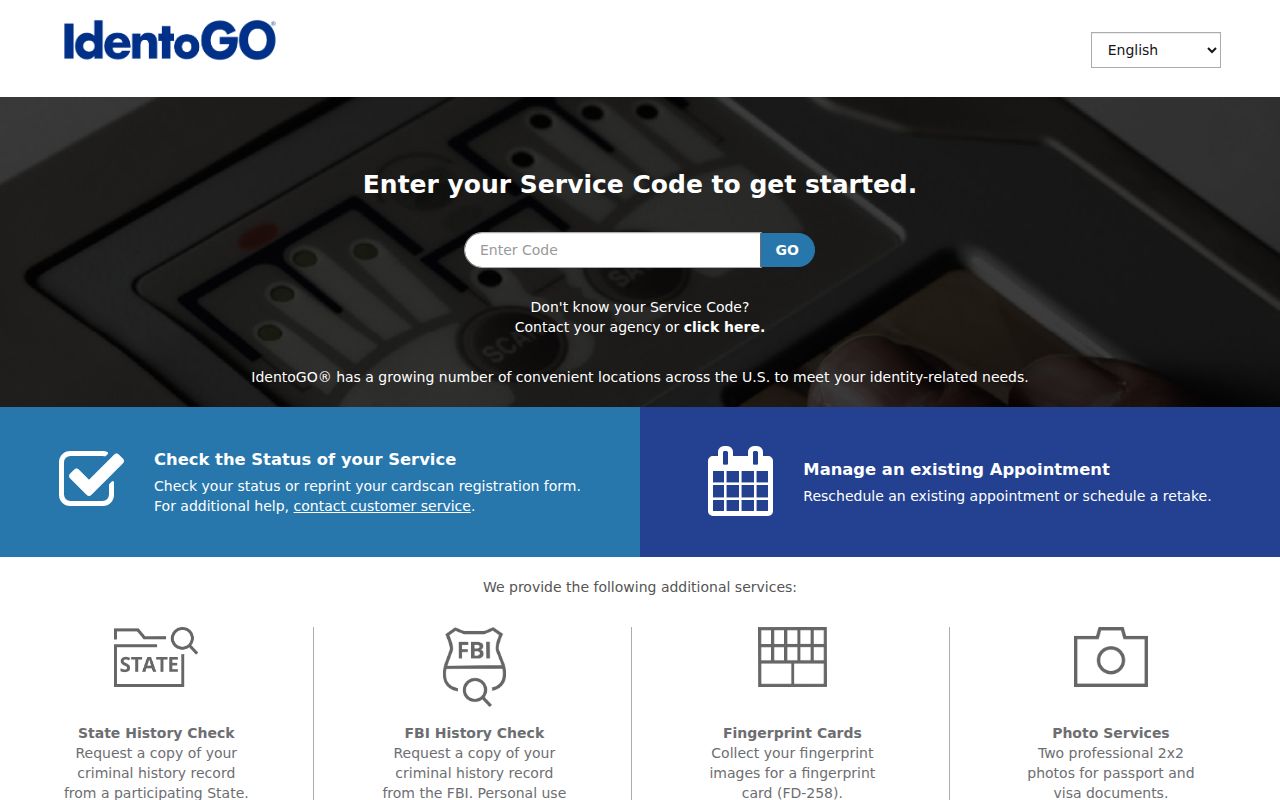
A personal review uses service code 11FT12 and costs $25 in the researched schedule, made up of a $10 vendor fee and $15 criminal-history fee. The DPS public name portal and a fingerprint review answer different questions.
The public DPS search asks for a full last and first name, with middle or maiden name and birth details available to narrow the match. Each online credit costs $1. A card purchase adds the published electronic surcharge, and a search with no match still uses a credit. Opening another possible-match record costs another credit. For that reason, check the spelling and birth fields before submitting. A preview can help distinguish possible results, but DPS cautions that a name and date of birth cannot provide the same identity certainty as fingerprints.
Four Guadalupe Criminal Record Offices
Guadalupe County records do not sit behind one counter. The District Clerk keeps felony filings at 211 W. Court Street, Suite 209, in Seguin. The County Clerk works in the same Court Street complex and keeps Class A and B misdemeanor files. The Sheriff's Office and records lobby are at 2617 N. Guadalupe Street. DPS is the statewide repository. Sending a request to the right custodian avoids a common delay.
The District Clerk's official page identifies the felony records desk and its judicial search route.
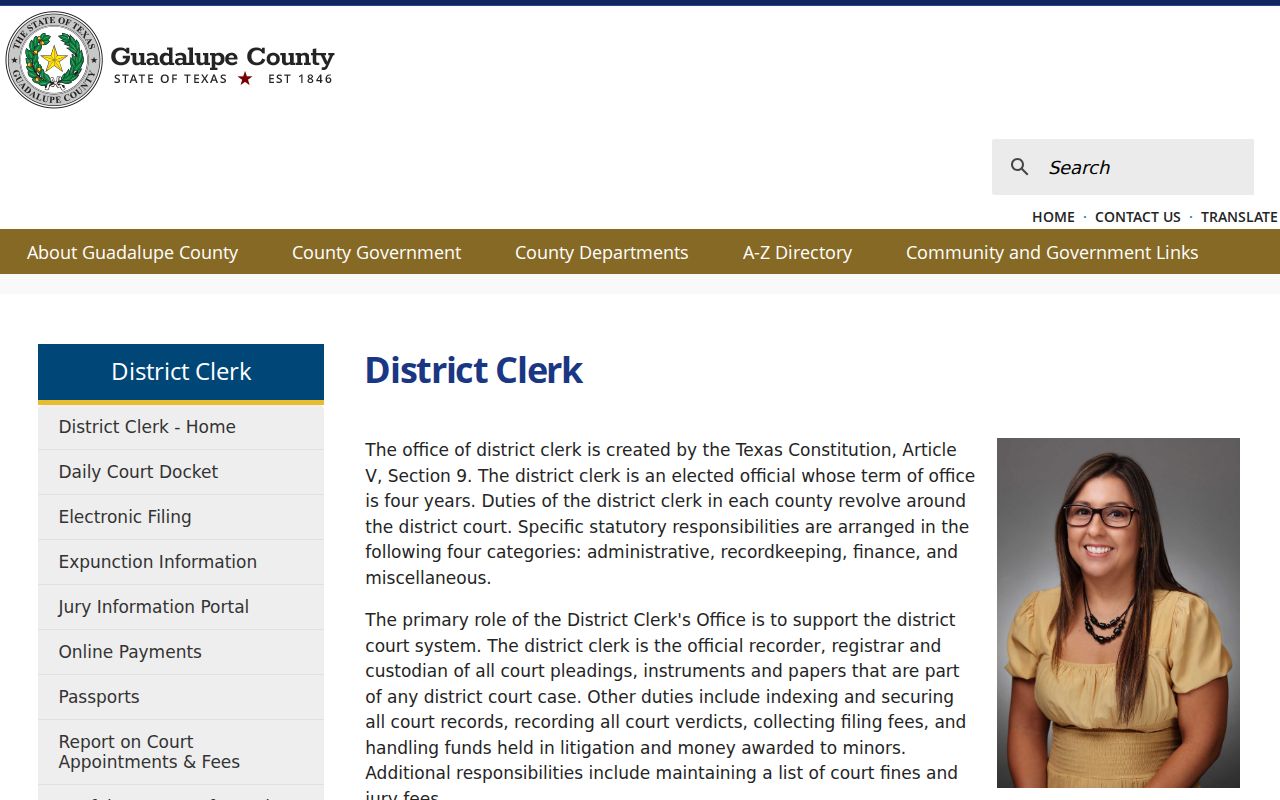
That office can supply filed felony papers and certified copies that are not exposed online.
The County Clerk court page covers misdemeanor records and electronic certified copies.
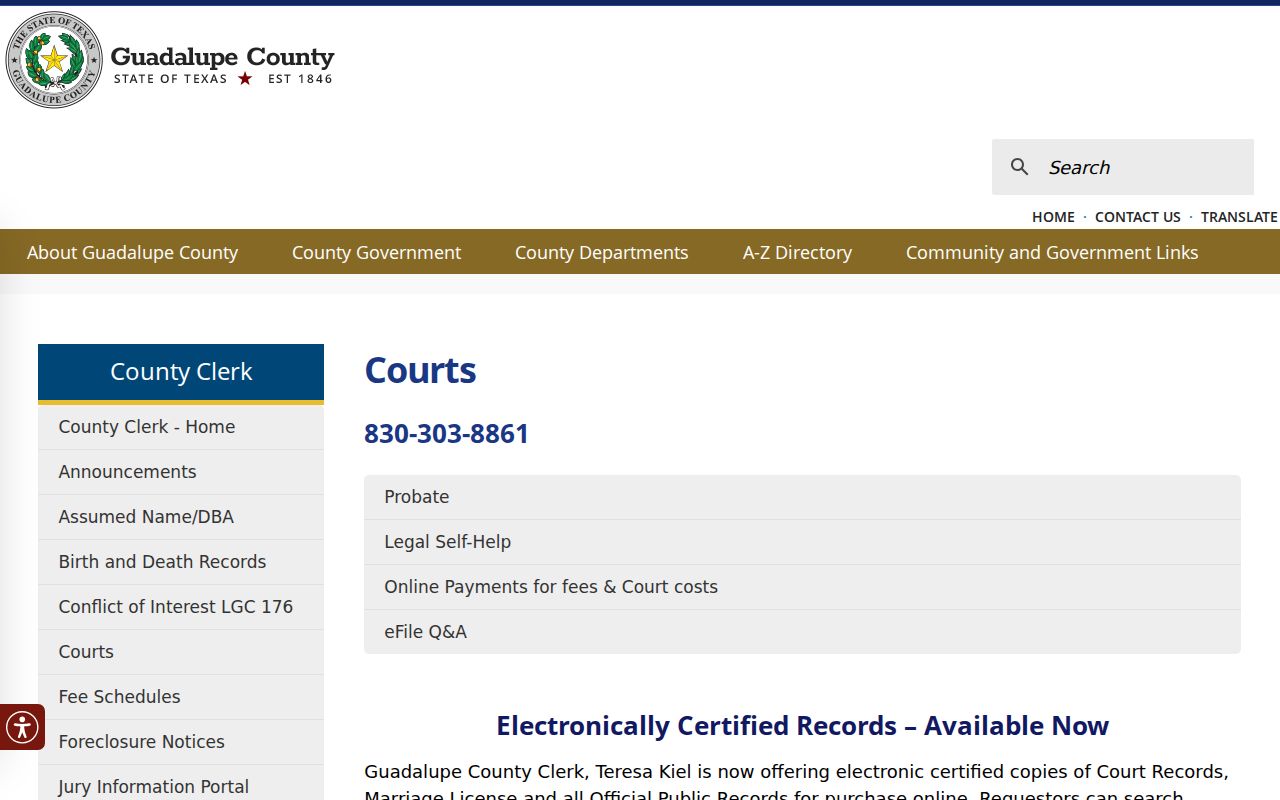
Its electronic certified service sends tamper-evident copies by email after purchase.
The Guadalupe County Sheriff's Office holds its own reports and jail files.
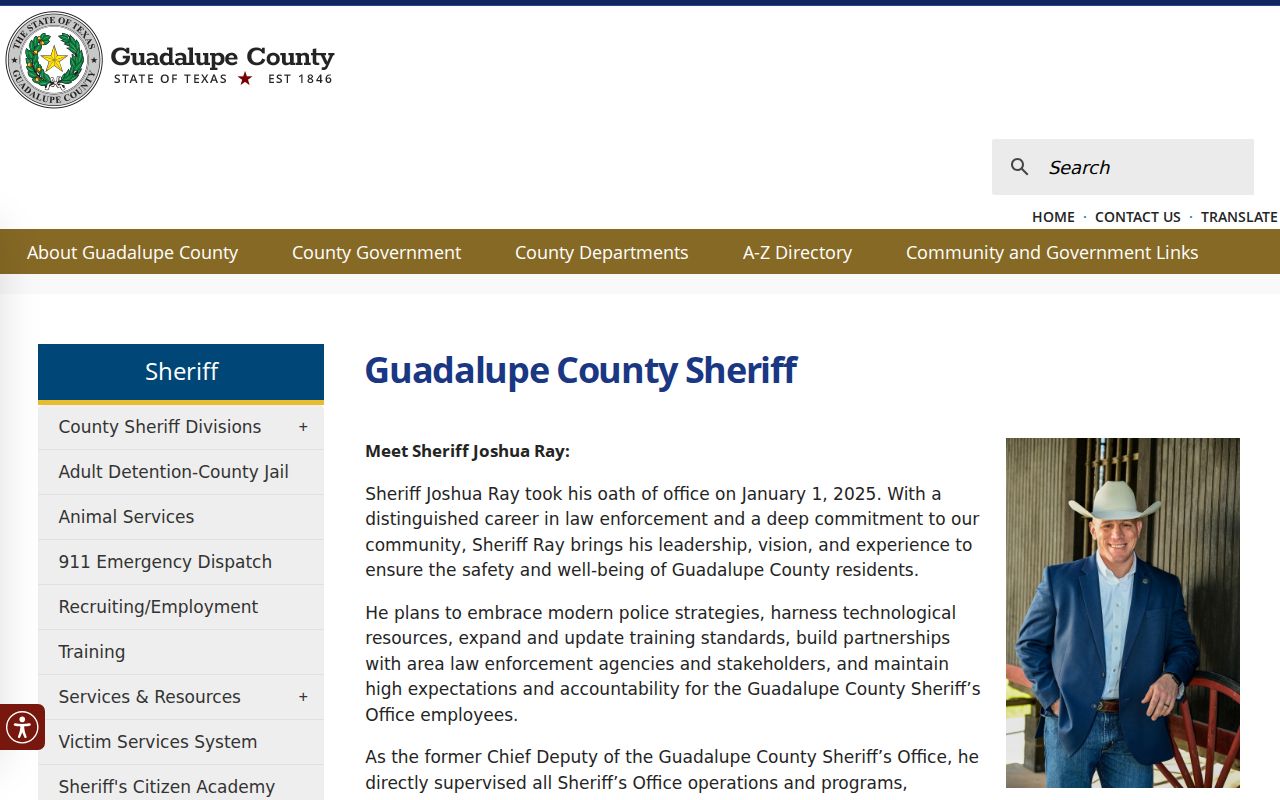
The sheriff cannot substitute for a clerk when the request seeks the court's filed case.
Types of Criminal Records
Each record begins at a different point in the Guadalupe County justice process. An officer's incident report states the initial allegation and narrative. Jail staff create a separate booking file after accepting a person into custody. A prosecutor may then file a complaint, information, or seek an indictment. The clerk's case file tracks hearings, pleas, orders, disposition, and sentence. DPS later links reported arrest cycles and court outcomes at the state level.
- Incident and arrest report: held by the sheriff, police, constable, trooper, or other arresting agency.
- Booking record: kept by the Guadalupe County Adult Detention Center for intake and custody.
- Court case file: held by the District Clerk for felonies or County Clerk for Class A and B misdemeanors.
- Warrant or capias: issued by a court and tracked for service by law enforcement.
- State history: compiled by DPS from fingerprinted arrests and reported dispositions.
These products can disagree without one being false. Timing, charge changes, sealed material, and incomplete links can all explain the gap. A few terms help keep the layers clear:
- Booking
- The jail's intake and custody record after a person is accepted.
- Indictment
- A grand-jury charging instrument commonly used in felony prosecution.
- Disposition
- The outcome recorded for a charge or case.
- Community supervision
- The Texas statutory term commonly called probation.
A court may dismiss one count and convict on another, so read charge-level outcomes rather than only the case caption. Bond data also has its own purpose. It describes release security or conditions, not the final result. When a summary uses an unfamiliar code, ask the clerk for the filed order or judgment instead of guessing from the abbreviation.
Guadalupe Booking Records by Numbers
The Guadalupe County Adult Detention Center reports a 598-bed capacity and about 8,000 bookings each year. It also reports roughly 3,600 transfers to courts. Those figures show why a county jail search is its own record channel. They do not measure convictions or a crime rate. One person may have more than one admission, and bookings may include holds or allegations that never become a conviction.
For a current or recent custody check, use Tyler Public Access or call jail records at (830) 303-6342 extension 2239. A sentenced state prisoner moves to the TDCJ Online Inmate Search instead. The official Guadalupe County arrest history page explains that transition and the records-request fallback in more depth.
What a Guadalupe County Criminal Record Shows
A criminal record must be read in context. Identity fields help distinguish people. The arrest cycle identifies an agency, date, and initial charges. The court file uses its own case number and shows the filed counts, settings, attorneys, bond, judgment, costs, and sentence when public. A jail profile focuses on custody and release. Protected identifiers, juvenile information, and sealed data may be absent or redacted.
| Name and identifiers | Display name, aliases, birth details, and state or federal identification numbers when lawfully shown. |
|---|---|
| Arrest and booking | Agency, arrest date, booking number, intake date, initial charges, bond, and custody events. |
| Case file | Court, case number, filed charges, pleadings, hearings, attorneys, and docket events. |
| Disposition | Dismissal, acquittal, conviction, deferred adjudication, or another charge-level outcome. |
| Sentence | Jail or prison term, fine, restitution, or community supervision ordered by the court. |
| Current status | Custody, release, bond, probation, or parole information from the proper custodian. |
Read each charge separately. A case may contain more than one count, and each count can have a different result.
Request Guadalupe Sheriff Records
Guadalupe County Sheriff's Office requests must be in writing. A requester may deliver the form to the records lobby during weekday public hours, send it by regular mail, fax it to (830) 372-1000, or use so.openrecords@guadalupetx.gov. The form asks for the requester, report type, report number when known, date range, people involved, location, and enough added facts to identify the material. A valid photo ID is required.
The GCSO open-records instructions state that processing can take up to ten days and that payment is due before release.
| Requested item | Published charge or rule |
|---|---|
| Report copy | $5 each, then $0.10 per page after ten pages |
| Recording copy | $75 on the current request form |
| Research or assembly | $25 per hour |
| Lobby payment | Cash in exact change |
| Mail payment | Money order or cashier's check; no cash or personal check |
A vehicle crash request leaves this workflow and goes to the TxDOT CRIS system, as the sheriff's form directs.
Public Access Laws
Texas law treats agency information, judicial records, state criminal-history data, restricted files, and registry information under different rules. The practical rule is simple: ask the office that created or holds the record. An open-records request to the sheriff does not compel the District Clerk to produce a felony pleading. Likewise, the public DPS product does not expose every item in a person's repository record.
Key statutes:
Texas Government Code Chapter 552 creates the Texas Public Information Act framework, subject to exceptions.
Texas Government Code Chapter 411 governs DPS collection, dissemination, and nondisclosure of criminal-history information.
Code of Criminal Procedure Chapter 55A sets the current expunction process and effects.
Code of Criminal Procedure Chapter 62 controls sex-offender registration and public registry duties.
Active-investigation details, victim information, juvenile data, personal identifiers, and sealed or expunged material may be withheld or redacted.
Find Guadalupe County Warrant Records
No complete public GCSO active-warrant database was verified in the research. Start with Tyler case and bond records, then confirm the result through the issuing court or the GCSO Warrants Division at (830) 379-1224. The division handles written orders from Guadalupe district and county courts and also attempts outside-agency warrants within the county.
Municipal and justice-court warrants may sit outside the main felony and misdemeanor clerk path. A fine-only failure to appear or capias pro fine belongs with the court that issued it. Sealed warrants, juvenile warrants, and sealed indictments will not appear in an ordinary public search. If a record suggests an outstanding warrant, ask the issuing office for appearance or bond instructions. Obtain proof after resolution because online updates may lag.
Note: A web result alone is not enough to resolve or safely act on a possible warrant.
Sealed, Expunged & Restricted
Expunction under current Texas Code of Criminal Procedure Chapter 55A can remove and generally destroy qualifying arrest and court records. Eligibility depends on the facts, charge, outcome, and waiting rules. A dismissal or no-bill does not by itself prove that every condition is met. An order of nondisclosure is different. It limits public dissemination of qualifying information but does not destroy the record, and named government or licensing entities may retain access.
The Guadalupe District Clerk expunction page identifies local and state offices that may need service.
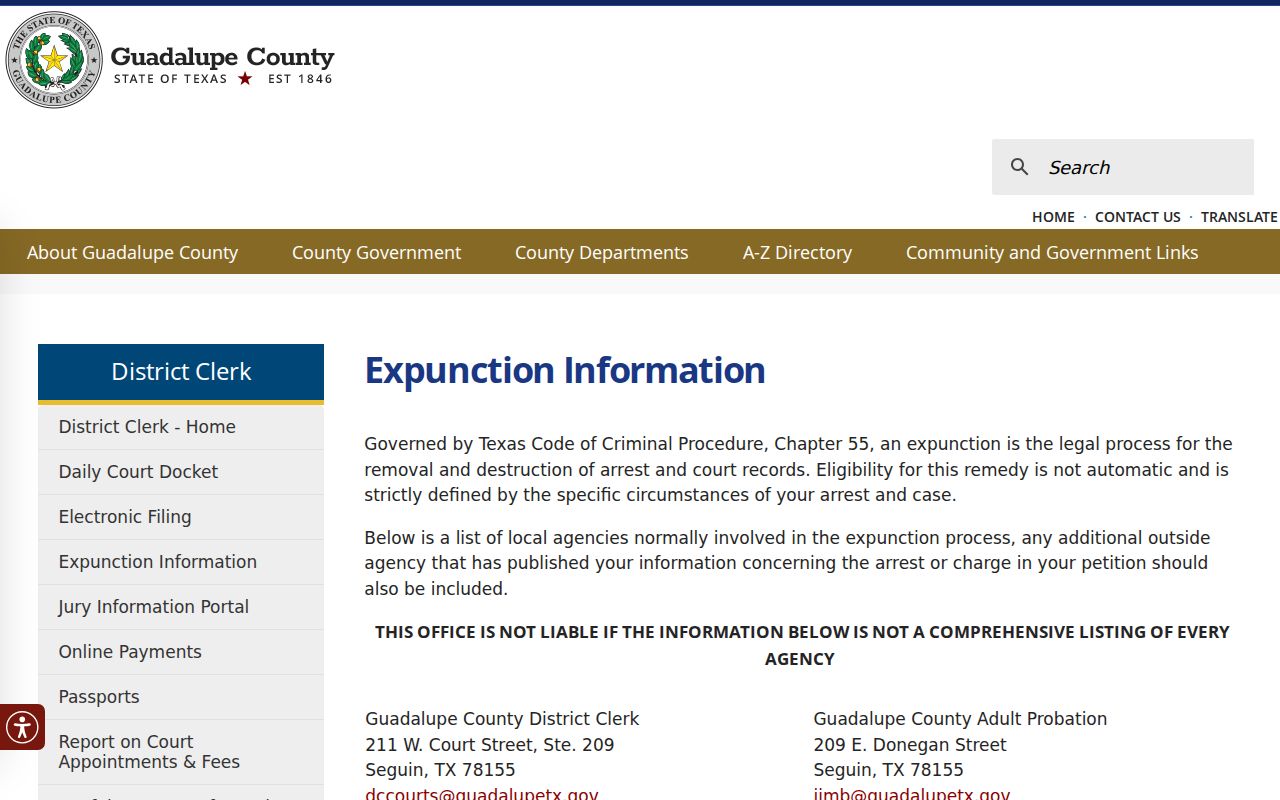
The list includes the clerks, sheriff, magistrate, probation office, Office of Court Administration, TDCJ, and DPS, but the county warns that it may not be complete. Juvenile files and protected victim or personal data follow separate restriction rules.
Guadalupe County Supervision Records
A court judgment shows whether Guadalupe County community supervision was ordered. Day-to-day supervision material belongs with the county Community Supervision and Corrections Department, not with the public case portal as a general name-search product. CSCD has offices in Seguin and Schertz and runs programs such as Field Intensive Supervision, Pre-Trial Services, High Risk Probation Court, a Mental Health Initiative, DWI education, and substance-abuse evaluations.
The Guadalupe County CSCD page identifies those offices and programs.
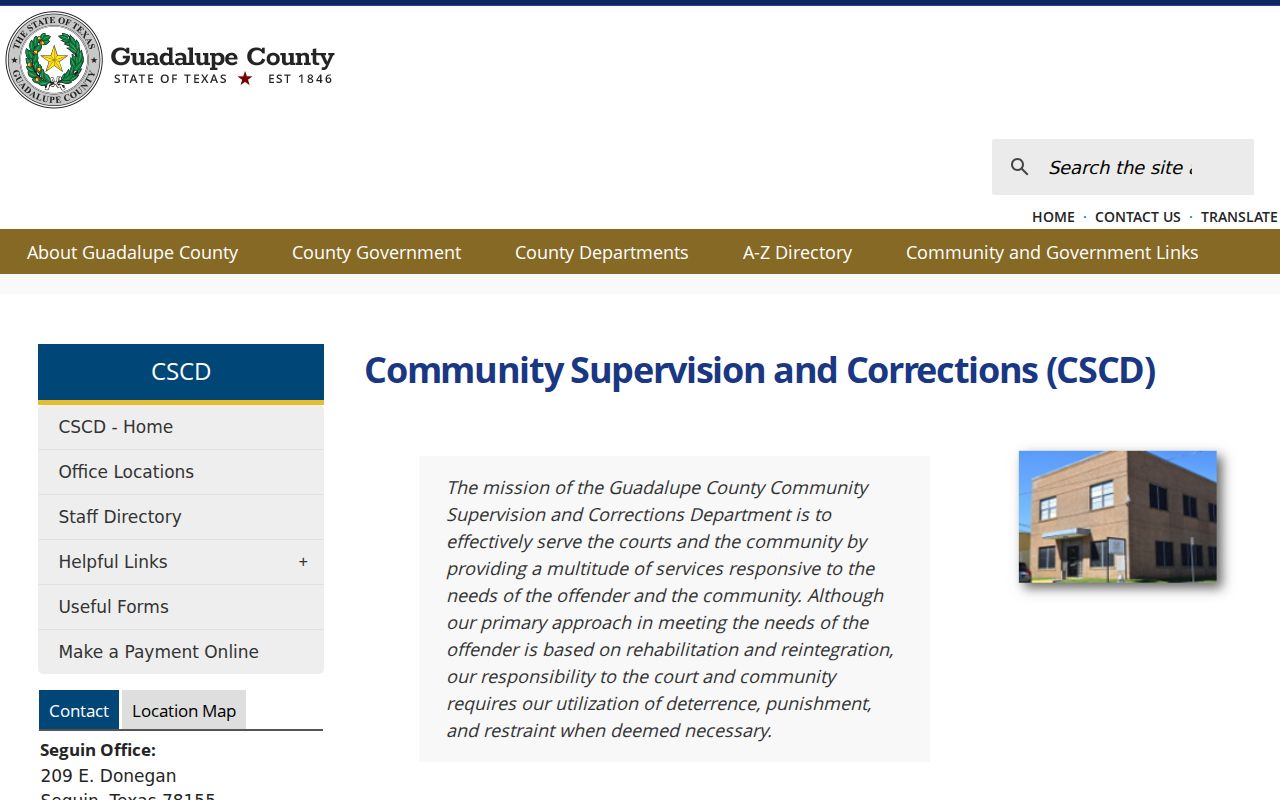
Verify the sentence in the court file, then contact CSCD where disclosure is lawful. State parole is a different system: the Texas Board of Pardons and Paroles makes release decisions, and the TDCJ Parole Division supervises releasees. A CSCD payment PID is an account identifier, not a public case-search key.
Criminal Records by City in Guadalupe County
City police reports stay with the city agency that created them, while jail and higher-court files can move into Guadalupe County systems. The three largest incorporated cities intersecting the county are New Braunfels, Schertz, and Seguin. New Braunfels crosses two counties and Schertz crosses three, so the offense location and receiving jail or court determine the right county clerk. Seguin is the county seat and sits closest to the county records cluster.
New Braunfels Criminal History
116,477 residents in the 2024 estimate. Route city police reports separately from the correct county jail and court.
Schertz Criminal History
44,428 residents in the 2024 estimate. Police records, municipal violations, and county bookings use different channels.
Seguin Criminal History
38,789 residents in the 2024 estimate. City records connect closely to the Seguin-based county jail and clerks.
How Guadalupe Records Reach Texas
An arresting agency creates the first report. When the Adult Detention Center accepts the person, jail staff create a booking record and take fingerprints. The magistrate advises the person of the accusation and rights and sets or reviews bail. Prosecutors decide which charge to pursue. District courts handle felonies, County Courts at Law handle Class A and B misdemeanors, and municipal or justice courts hear eligible fine-only matters.
Record flow: Arresting agency › Guadalupe County jail › prosecutor and clerk › court disposition › Texas DPS repository.
The statewide re:SearchTX platform is account based, but the Office of Court Administration reports that its public portal excludes criminal case records. Guadalupe criminal matters therefore remain with local clerks and Tyler Public Access.
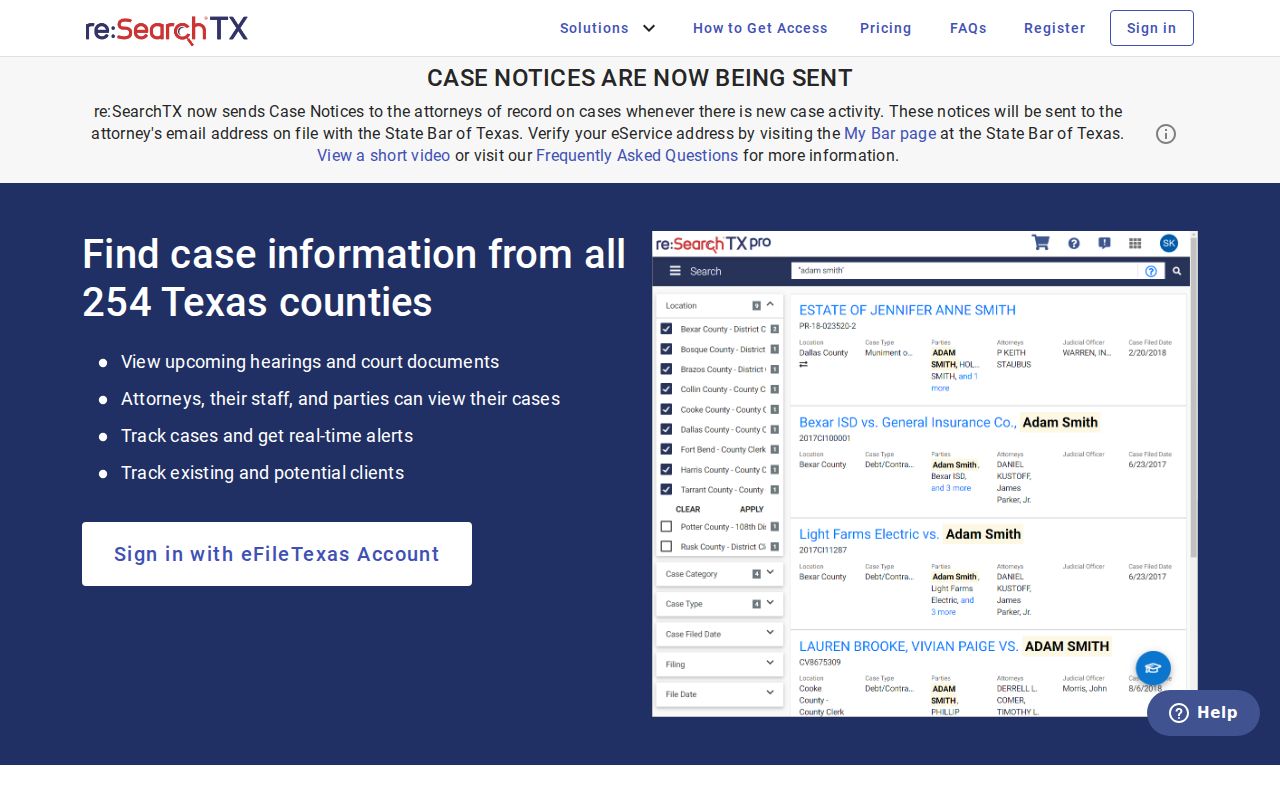
This division explains why no single lookup is complete. Reporting lag, incomplete identifiers, or an unlinked disposition can create gaps between the county docket and DPS output.